

Welcome to the May Camden Guides Newsletter, and as well as a range of walks over the coming month, we also have a special announcement, that:
Applications are now open for the Camden Tour Guide Course starting in September 2024.
The course will enable you to develop the skills required to plan, prepare and deliver walking tours, in the London Borough of Camden. Tuition on guiding skills is complemented with learning about the history, architecture, tourist attractions and facilities of the Borough of Camden. The borough has a particularly rich history in terms of buildings, institutions and residents which can be used by guides to interpret the area for diverse audiences.
Our previous students rate it as excellent value.
You are welcome to attend a Meet the Guides event where we offer a free hour-long walk to those considering the Camden course. This year’s Meet the Guides walks will be on Thursday 16th May, Wednesday 19th June and Wednesday 3rd July at 6pm and will take place around the King’s Cross area. Please reserve a place at:
The following walks are taking place during the coming weeks:
Humble Homes: A walking tour of workers’ housing in Camden

Be it ever so humble there’s no place like home
Join Ellika, qualified Camden Tour Guide as she explores the streets covering the foothils of Hampstead Heath and the often groundbreaking styles of domestic architecture that can be found there. Learn how the architecture influenced the lives of the residents and how the residents impacted the architecture
Visit the Iconic Isokon , the first modernist block of flats in Britain which pioneered the concept of minimalist stylish city living. Hear more about the lives of residents such as Agatha Christie, Walter Gropius and Soviet Spy Arnold Deutsch
The modernist theme continues as we explore the Fleet Road Estate – the first estate in Neave Brown’s ambitious social housing building programme during Camden Council’s golden age. The humanist approach to town drew international acclaim but lost favour in 1970s Britain – make your own mind up as to what you think about it.
Dive back in history to the Georgian workers’ cottages and cobbles of the charming Little Green St – find out why the cottages have such long gardens and perhaps recognise it from a 1960s pop video
Explore the eye-catching terraces of houses painted in their co-ordinating pastel shades – discover where the trend began and how the colours are decided …oh and make sure you take a few photos for the instagram!
This walk takes place on the 12th of May at 11:00 and can be booked by clicking here.
Curious Camden Town
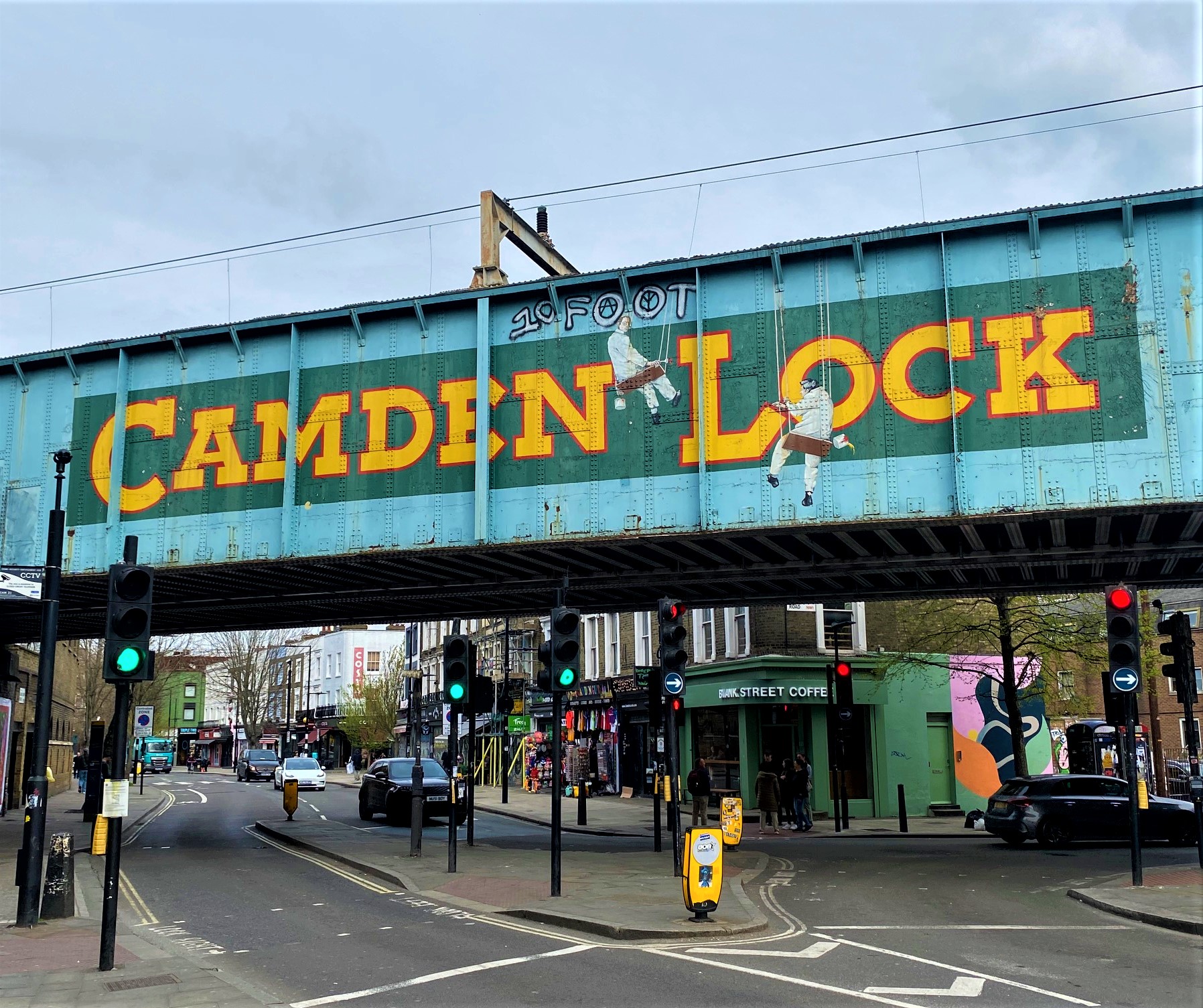
Discover Camden Town with Elena, a resident of 30+ years.
It’s lively, it’s quirky, it’s cosmopolitan and it’s packed full of history! Camden Town is all of these things. It’s a neighbourhood that has been shaped by many communities, from the Irish to the Greek-Cypriots, each leaving an indelible mark. Charles Dickens, a very unhappy former resident, immortalised Camden Town’s poverty, squalor and deprivation in his literary musings.
Camden Town was developed at the end of the 18th century with the aim to attract the wealthy middle classes, but the arrival of the railways put a stop to those ambitious plans. On the plus side, it now boasts the best-preserved railway heritage complex in the UK!
On this walk you will hear about the gin warehouses that once lined the Regent’s Canal, the Victorian ice-wells now hidden from view and the hundreds of horses working in the goodyards. You will also discover how Camden’s numerous pubs, ballrooms and warehouses have become a mecca for music makers and music lovers over the decades.
This walk takes place on the 14th of May at 11:00 and can be booked by clicking here.
Meet the Guides – Camden Tour Guides Association FREE walk

This FREE walk is aimed at anyone who is interested in learning about becoming a qualified Camden Tour Guide, offering an opportunity to meet existing Camden Guides, go with them on a tour around the King’s Cross area and have a chance to talk to them about the course and what it’s like to be a tour guide in Camden today.
The next course starts end September 2024. If you are unable to come on any of our Meet the Guide dates but are interested in the course, then please email course@camdenguides.com or visit our website for information at https://camdenguides.com/training.
This event takes place on the 16th of May at 18:00 and can be booked by clicking here.
Rebels and Blue Stockings: The New Woman in Bloomsbury

Free-spirited and independent, educated and uninterested in marriage and children, the figure of the New Woman threatened conventional ideas about ideal Victorian womanhood. On this walk we will discover how Kate Greenaway, a female artist from a working class background, Eleanor Marx, a regular at the British Library Reading Room and the archeologist Mary Brodrick found a life outside conventional Victorian norms. The founding of Bedford College, led to higher education for women, and the creation of College Hall enabled women students to study independently.
19th century Bloomsbury was a hub of activism. Women were pushing against laws confining them to traditional roles. Pascal Theatre Company is running a two-year Lottery Heritage Funded project: Women for Women: 19th century women in Bloomsbury Current Projects – Pascal Theatre Company (pascal-theatre.com) We are celebrating those who worked at breaking down barriers and who fought to create opportunities for future generations. For more information and to get involved in research, workshops or events contact: sally@pascal-theatre.com
This walk takes place on the 19th of May at 14:00 and can be booked by clicking here.
Gin Lane: Thieves and Thief-takers in the Night-Cellars of Seven Dials

Now it’s trendy and pretty, but 18th-century Seven Dials was notorious for poverty and crime. With no organised police force, thieves, highwaymen and fences bribed those hired to catch them, meeting in low-down dives where they spoke a secret language called flash. The notoriously corrupt Jonathan Wild captured thief Jack Sheppard more than once, but Jack made dramatic escapes from prison aided by his sexworker-partner Edgworth Bess.
With gin selling at a penny a glass, carousing was full-on in areas outsiders called rookeries, thieves’ kitchens, the Holy Land (because of the Irish presence) and, for Drury Lane’s red-light zone, Little Sodom. A range of middle-class spies, social investigators, reporters and slum-tourists came to look and sometimes participate in goings-on they found appalling and titillating. John Gay portrayed popular hero Jack Sheppard and Public Enemy Jonathan Wild in the characters of Captain MacHeath and Mr Peachum, in The Beggar’s Opera, London’s favourite theatre-piece throughout the 18th century. What fun!
This walk takes place on the 26th of May at 13:00 and can be booked by clicking here.
Creative, Cultural, Colourful Fitzrovia

Fitzrovia is an area to savour and where better to spend a Spring Sunday afternoon than exploring its elegant squares, Georgian streets and cosmopolitan feel? See some truly outstanding architecture from the 18th, 19th, 20th and even 21st centuries. Walk through secret pocket parks. Hear stories of the diverse communities that have lived and worked in Fitzrovia and how it has changed and transformed over time. Learn about the recent improvements in public realm brought about by the West End Project. Meet some of the extraordinary individuals who have lived in the area including Olaudah Equiano, Mary Prince, Lady Ottoline Morrell, the colourful habitués of the Fitzroy Tavern and many more. All proceeds from this walk will go towards the work of Amnesty International to fund their work supporting prisoners of conscience and campaigners for democratic rights around the world. As there is no upper limit to your contributions please contribute generously!
This walk takes place on the 26th of May at 14:30 and can be booked by clicking here.
Living on the Edge: Hidden Holborn and Little Italy

Some of the most interesting areas around the City of London are places lived in and worked in by people who were not based inside it but needed to be near it. A great example is the area just north of Holborn, on the north-western edge of the City.
A medieval bishop’s palace (you can still go into the crypt, built in the 1270’s): a Tudor-era pub down a narrow alley: multiple diamond dealers and the site of a famous heist by geriatric thieves (the “diamond wheezers”): London’s first social housing project: a half-timbered Tudor hall which survived the Great Fire: we see all these on the walk.
We also focus on exploring “Little Italy”: not much recognised now, in the 1800’s a few streets here were teeming with Italian immigrants, both middle-class artisans making barometers and poorer people selling ice cream and playing barrel organs.
This walk takes place on the 2nd of June at 11:00 and can be booked by clicking here, and on the 16th of June at 11:00 which can be booked by clicking here.
Slums and Squares and Rock n’Roll

You will probably know lots of bits of the St Giles’ area: Tottenham Court Rd tube, Centrepoint, Shaftesbury Ave, Seven Dials…but you probably don’t know how the area came to be as it is. A fascinating story of ancient roadways meeting, a medieval leper colony, a failed posh residential district, a notorious Victorian slum and the most unspoilt Georgian square in London. I would be delighted to help you explore all this (and see the street where Elton John worked as a tea boy and the Rolling Stones and Genesis recorded their earliest singles).
This walk takes place on the 2nd of June at 14:00 and can be booked by clicking here.
London’s Sex Industry and the Stage in the Long 18th Century

Charles II lifted the Puritan ban on theatre-going, and by 1700 London was sex-capital of Europe. This walk starts with the stage at a time when all actresses were assumed to be prostitutes and theatres a place for clients to find them. We pass through areas where street-walkers and bawdy houses were closely linked with playhouses, and we hear about high-class masquerades where actress-courtesans like Sophia Baddely might appear. There are the bawds who kept houses, the women who worked in them, like Nell Gywn and Sally Salisbury, and Harris’s List, where they might advertise.
We hear about homosexual Molly Houses as well as Jelly Houses, Coffee Houses and Bagnios. Links between corrupt government officials and criminals formed the plot of John Gay’s The Beggar’s Opera in 1728, with its cast of thief-takers, highwaymen, pickpockets and sex workers like Jenny Diver who met in flash houses where they spoke a secret language. The unscrupulous Society for the Reform of Manners tried to close down vice, but things began to change when Social Reformers said women selling sex were victims needing rescue.
The walk starts in Lincoln’s Inn Fields and passes through Covent Garden and surrounding streets like Drury Lane, where ordinary folks lived who sold sex – orange women, flower girls and patrons of dance halls. The underworld called this red-light area where you might meet Edgworth Bess the Hundreds of Drury.Charles II lifted the Puritan ban on theatre-going, and by 1700 London was sex-capital of Europe. This walk starts with the stage at a time when all actresses were assumed to be prostitutes and theatres a place for clients to find them. We pass through areas where street-walkers and bawdy houses were closely linked with playhouses, and we hear about high-class masquerades where actress-courtesans like Sophia Baddely might appear. There are the bawds who kept houses, the women who worked in them, like Nell Gywn and Sally Salisbury, and Harris’s List, where they might advertise. We hear about homosexual Molly Houses as well as Jelly Houses, Coffee Houses and Bagnios. Links between corrupt government officials and criminals formed the plot of John Gay’s The Beggar’s Opera in 1728, with its cast of thief-takers, highwaymen, pickpockets and sex workers like Jenny Diver who met in flash houses where they spoke a secret language.
The unscrupulous Society for the Reform of Manners tried to close down vice, but things began to change when Social Reformers said women selling sex were victims needing rescue. The walk starts in Lincoln’s Inn Fields and passes through Covent Garden and surrounding streets like Drury Lane, where ordinary folks lived who sold sex – orange women, flower girls and patrons of dance halls. The underworld called this red-light area where you might meet Edgworth Bess the Hundreds of Drury.
This walk takes place on the 8th of June at 13:00 and can be booked by clicking here.
Hampstead: the village on the hill

You probably know Hampstead as a very attractive area of very posh houses and very famous people. But why is it so lovely to walk around?
It’s a lot to do with a hill which prevented major roads and any railways being built: so uniquely in London it preserves a Georgian village streetscape. It also had many springs which supported a Tudor laundry business and then a fashionable Spa attraction in the 1700’s.
And its healthy air and great views have always made it an attractive place for the wealthy, and for artists, writers and entertainers. So there are plenty of lovely houses to see: but this walk also explores buildings such as old workhouses and bath houses which remind us that plenty of “ordinary” people lived there too!
But above all its a beautiful old village on a hill: do come and explore it!
This walk takes place on the 8th of June at 14:00 and can be booked by clicking here.
Meet the Guides – Camden Tour Guides Association FREE walk

This FREE walk is aimed at anyone who is interested in learning about becoming a qualified Camden Tour Guide, offering an opportunity to meet existing Camden Guides, go with them on a tour around the King’s Cross area and have a chance to talk to them about the course and what it’s like to be a tour guide in Camden today.
The next course starts end September 2024. If you are unable to come on this date but are interested in the course, then please email course@camdenguides.com or visit our website for information at https://camdenguides.com/training.
This walk takes place on the 19th of June at 18:30 and can be booked by clicking here.
Our next newsletter will be on the first Saturday of June, but please check our online calendar as new walks are being added between newsletters. The calendar can be found on our home page by clicking here.