

As part of our series celebrating 60 years of the London Borough of Camden, this week’s blog explores the vibrant world of street art across the borough.
Most people visiting London interested in Street Art or Graffiti will be directed to Shoreditch
in the East of London. That is the area that is most famous for the density of art on display.
Camden Town is lesser known but is also home to a number of excellent works. They are off the main streets in some cases but for those in-the-know, there is a wealth of art to be explored here.
There are many murals dedicated to the famous Camden girl, singer – Amy Winehouse.
In fact, there is an Amy Winehouse Street Art Trail. The image of her as an Angel cannot be missed on the wall of the well-known music venue Koko at Mornington Crescent. She also features on the wall outside her favourite Camden Town pub – the Hawley Arms. There is an Amy by the Chilean artist Otto Schade with his distinctive style using ribbons to create images.
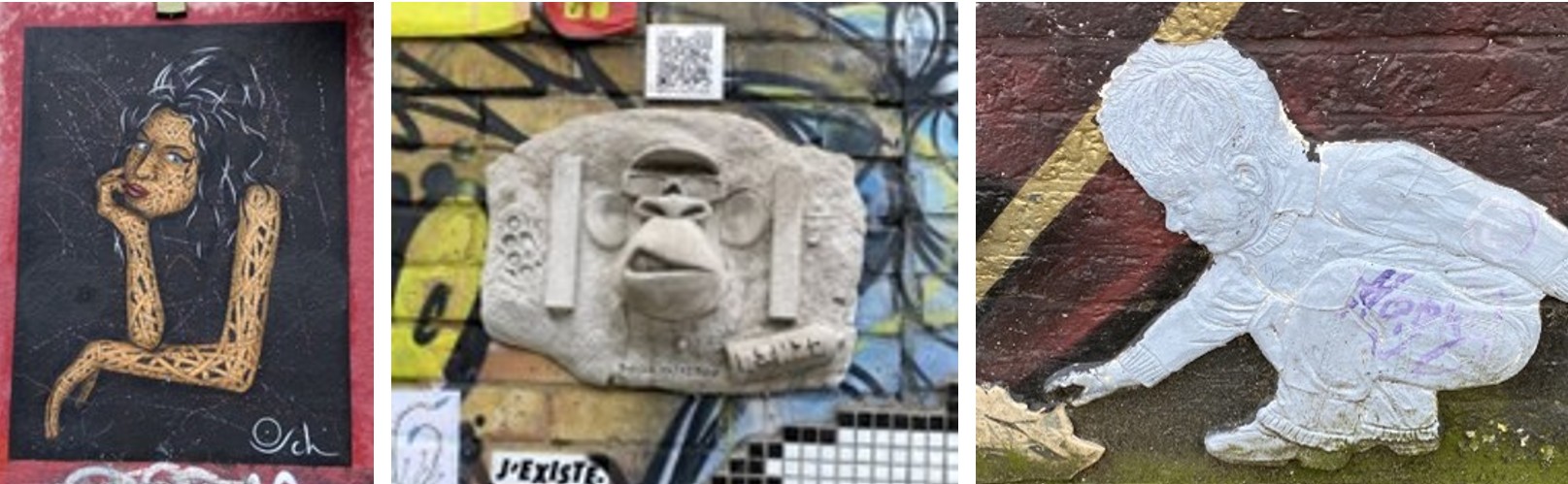
Artists from as far away as Sao Paulo, Brazil have left their mark. An artist known as Onesto has a large piece under the bridge on CastleHaven Road.
Not all street art is painted, stencilled, or sprayed. There are 3D reliefs as well. The piece below is by a German artist called Ronzo. His work is to be found all over Shoreditch. His most famous character is the Crunchy Monster. Ronzo’s Crunchy monsters are munching on a pound coin and refer to the global financial meltdown Of 2008 when amongst other disasters – Lehman’s bank failed. The Monkey faces are also prevalent in Shoreditch.
The clay image shown below is by a lady artist called China Girl. This artist comes from Austria and professes to be the first street artist using clay which she then fixes on walls.
As I mentioned, a lot of the work is off the beaten track but there is an Estate called the Ferdinand Estate that has an absolute treasure trove of work. Not all of it is accessible but much of it can be seen.
The estate is a short walk from Chalk Farm station and features work by the famous Inkie, one of Bristol’s Graffiti heritage which includes also includes Banksy – the most well-known British artist who has managed to maintain his anonymity.
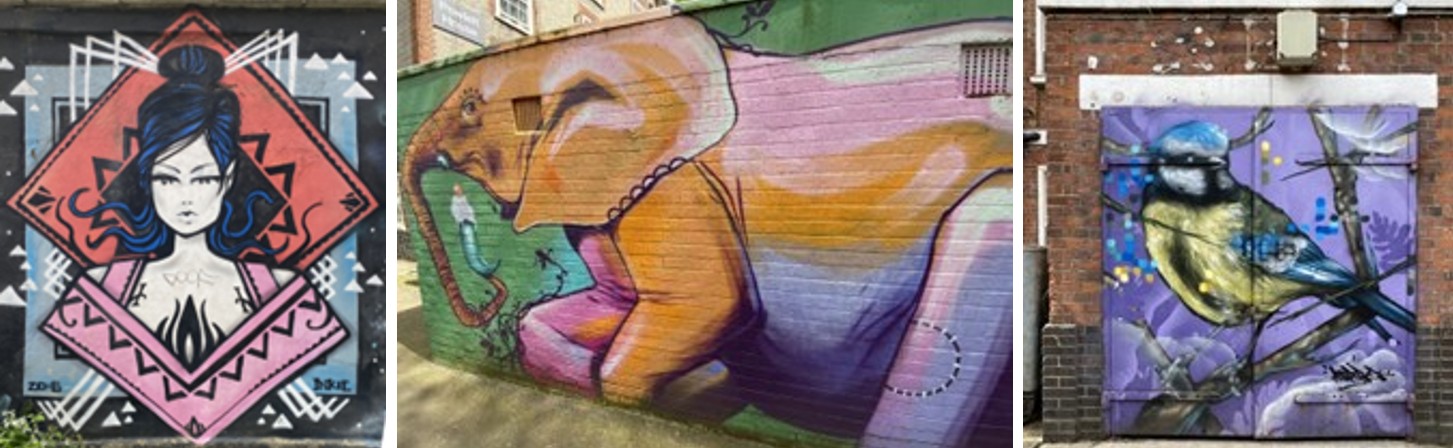
If graffiti is illegal, and I have heard that the UK is especially hard on offenders – how has this been allowed?
The answer is that permission was given by Camden Council to an organisation named Global Art to liven up a grey and drab housing estate. Artists from 10 countries and all over the UK got to work and the result is stunning. The residents love the vibrant colour the work has added to the estate.
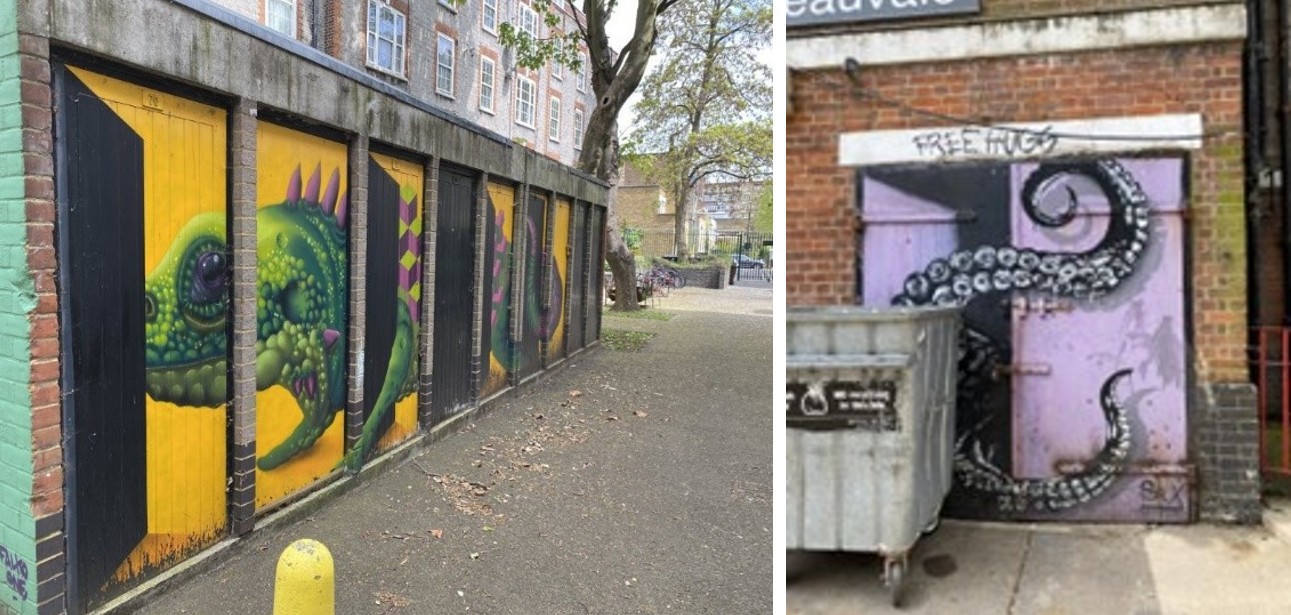
Right on Camden Council. However, if they catch you painting without permission – watch out! Especially if what you are doing is “tagging”. Up until this point, I have been discussing images that are still classed as graffiti, but some people would call post-graffiti. Complex murals are painted with permission. These works take time and artists paint openly. They write their Instagram details, so they are contactable. They sell their work on-line.
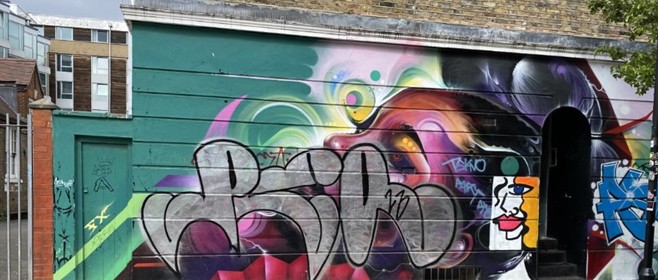
Tagging on the other hand is letters, words, names. Young artists usually start with tagging – just spraying their names or initials – making their mark. Tagging is perceived as rebellious and, in many cases, – vandalism. It is done at night and in many cases taking huge risks climbing on roofs and hanging off ropes on the side of bridges. if the police do catch you at it then it could be a prison sentence. However, many of them are as young as 13 or 14 – so that will be young offender institutions for them.
The most basic tagging is often done on top of other artist’s work. This is an act of rebellion against the artists they perceive as having sold out! Banksy is frequently a target of this but in his case, he is not perturbed. His work is often protected by a Perspex shield by the authorities – no wonder the other artists see this as a sellout. It is not at Banksy’s request, but it just highlights the hypocrisy and double standards of the powers that be.
If these youngsters have any talent, they will eventually progress to bubble writing and then murals and then be selling their work as well! The ultimate sanitisation of street art is when it has been paid for by a big company to paint a mural advertising their products. This is becoming a common sight in Shoreditch but not yet in Camden.
So, a rebellious act becomes commercialised and thus sanitised to a degree.