

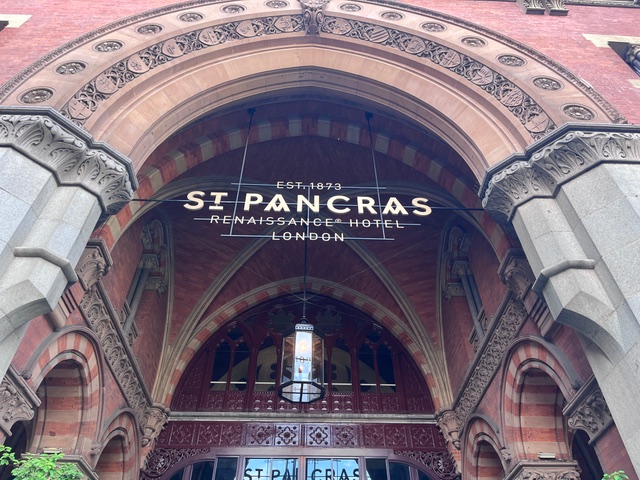
For those of you who can remember a time before Google, you might recall what looked like a fairy tale palace hiding behind some boards. I couldn’t understand why such a beautiful building had been left boarded up and abandoned.
Fast forward to today: the St Pancras Renaissance Hotel is one of London’s most recognisable buildings, and the whole area around St Pancras and Kings Cross has been rejuvenated. We are lucky that British Rail’s plans in the 60’s to bulldoze the area and amalgamate the stations was thwarted by a public movement to protect it.
The hotel’s history is intertwined with the development of the railway, and its story started in 1865 when Midland Railway ran a competition for the design of a hotel next to St Pancras station. It was won by Sir George Gilbert Scott – although he entered a design much larger and more expensive than the brief, he still won!
He was inspired by the Palace of Westminster, what we know better as the Houses of Parliament. Augustus Pugin (the architect of that building) was his hero. George believed that the Gothic revival style was Christian – and he was a bit of a magpie – as although incredibly talented he copied details from that, and the churches that he had visited on the Continent.
George was the first in the Gilbert Scott dynasty, and one of the most famous, successful, and prolific architects of the 19th century – with 29 architects working for him he had the largest practice in Europe.
Although he had designed the Foreign Office in Whitehall before this, he had had to do this in a classical style (after the Prime Minister, Lord Palmerston demanded it), which he regarded as pagan!
I think the frustration in that project let his Gothic fantasy run riot in his designs for the hotel. It has a stunning red brick façade, and the interior is an architectural wonderland, combining Gothic detail with bold and modern methods of construction.
The hotel opened as the Midland Grand Hotel in 1876 and had the first revolving door in the country! It also had one of the first lifts, known as ‘rising rooms’ or ‘ascending chambers’ and even ‘vertical railways’ before we settled on the word ‘lifts’.
But only 59 years later (1935) it was forced to close by spiralling costs, and because things had moved on. It’s hard for us to imagine, but it only had 8 bathrooms for 300 rooms – while other hotels built not long after had introduced ensuite rooms, so it had become redundant almost overnight.
It was renamed St Pancras Chambers and used as offices for the railway companies. In the 80’s its failure to meet fire safety regulations led to it being abandoned – and that is when I had first seen it. English Heritage oversaw the exterior restored and made it structurally sound in the 90’s. It’s slightly ironic that it was the next development of the railway – Eurostar in the 2000’s – that saw the area revived.
Planning permission was granted in 2004 for its redevelopment, and it re-opened as the St Pancras Renaissance Hotel in 2011 following a multi-million-pound renovation which was overseen by English Heritage, and I think if George Gilbert Scott visited today, he would still marvel at his Gothic masterpiece. A fairy tale building that has stood the test of time.