

Our guide Lesley Thompson reveals some of the fascinating and perhaps unexpected places that lie either side of the now-buried River Fleet in her walk ‘Beating the Bounds’ along the Camden and Islington border.
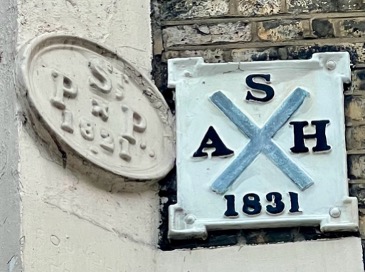
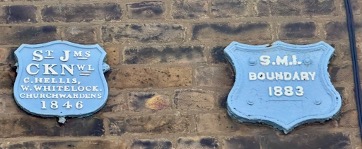
‘Beating the Bounds’ around the borders between parishes, land ownerships and similar is an ancient tradition, where the boundary was literally paced out and marked with stones each year. These original dividing lines sometimes followed natural features or roads, and the River Fleet was an obvious border between different jurisdictions, which today include Camden and Islington boroughs. There are also geographic clues to the presence of the subterranean river, such as winding routes and dips in the roads. Nearby, the sharp-eyed might spot old written markers on walls, and on bollards, for previous boundaries of parishes, vestries, water conduits and historic landowners.
Photos © Lesley Thompson
These old parishes eventually became the first metropolitan boroughs at the turn of the 20C, then amalgamated in 1965 to form today’s London boroughs. Look up, look down and you can still spot old signs for St Pancras, St Mary Islington, St James Clerkenwell and St Andrew Holborn parishes, then St Pancras, Islington, Finsbury and Holborn boroughs.
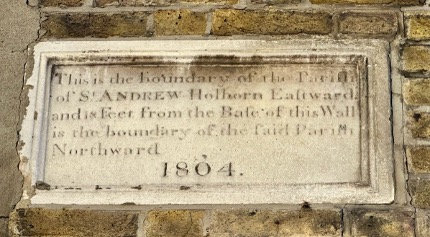
Photo © Lesley Thompson
The River Fleet is a major tributary of the River Thames, once surrounded by watery wells and visible side streams. Some became evocatively-named spas and pleasure gardens serving medicinal waters with ever more extravagant claims of cures for ill health – at the Cold Bath, Black Mary’s, St Chad’s and Bagnigge Wells. Some of the water sources were then turned into conduits, supplying cleaner drinking water to various institutions in the City, such as the White Conduit which fed Greyfriars Monastery.
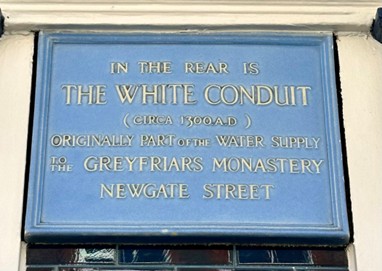
Photo © Lesley Thompson
Lambs Conduit Street in nearby East Bloomsbury is named after William Lambe, a member of Clothworkers livery company, who paid in 1577 for a spring to be piped to Snow Hill. Parts of this area are still owned by two Elizabethan philanthropic estates that founded (and still support) schools in Rugby and Bedford, and border markers and plaques identifying their lands remain.
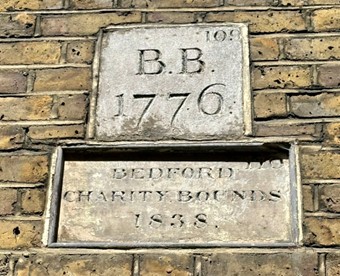
Photo © Lesley Thompson
As well as old signs, the area teems with varied architecture from pretty Georgian and Victorian terraces to old burial grounds, narrow passages that were once slums and restored industrial buildings; there are stories of mediaeval monks, Tudor and Victorian philanthropists, and a dynasty of 19C architects and builders
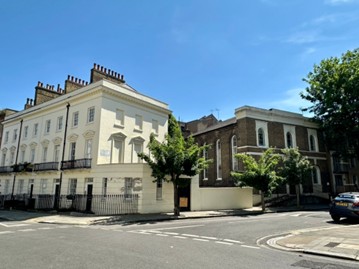
Photo © Lesley Thompson
Providing there’s been rain, walkers can often hear the still-flowing River Fleet below a grating….
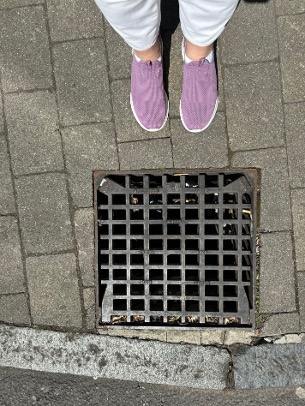
Photo © Lesley Thompson
On Lesley’s tours, it’s usually also possible to end with a visit to the remains of the Clerk’s Well from which Clerkenwell takes its name.
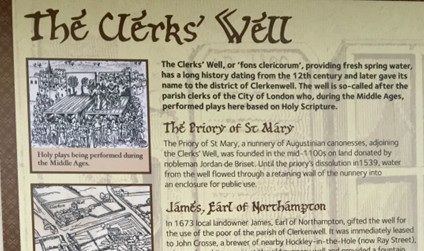
Partial photo of panel in the Well Building © Lesley Thompson
Please join Lesley to explore all this and more on an exploration of the south-east boundary of today’s Camden borough, plus many nooks and alleys to either side. Saturday 7th June at 11am (and a further date on 2nd July), book via this link:https://www.eventbrite.co.uk/e/beating-the-bounds-from-kings-cross-to-farringdon-tickets-790151322877