


If you look at the red brick building next to the Crown in recently re-landscaped Princes Circus you might spot a blue plaque above the door and between the first floor windows at the far left.
Fanny Rollo Wilkinson was the first woman to qualify and work as a professional landscape gardener and the plaque is on her first Bloomsbury home. She moved into what was then 15 Bloomsbury Street (later redesignated 239-241 Shaftesbury Avenue) in 1885 just before the new north-south route that was to become Shaftesbury Avenue was completed. Although the new road had swept away the slums of St Giles’ Rookery, the area was still far from desirable and not a location many middle class Victorian women would have chosen.
Wilkinson was born on 6 June 1855 into a prosperous family in Manchester. When her father (a physician, landowner and recent President of the British Medical Association) died unexpectedly, the family moved from Manchester to Middlethorpe Hall near York where Fanny Wilkinson said that she developed her love of gardening.
Professional Training at Crystal Palace
Although domestic gardening was an acceptable interest for a woman, Fanny Wilkinson’s decision to undertake professional training in landscape gardening was exceptional. In April 1881, the Crystal Palace Company had proudly announced in the London press that they were to open a new division of their School of Art, Science, and Literature – the School of Gardening and Practical Floriculture ‘designed particularly for the educational training or preparation by practical instruction of young men intending to be professional gardeners or nurserymen’ (South London Press). By July of the same year, another notice appeared announcing that ‘In consequence of numerous applications, (special arrangements had been made) for the admission of lady students’ (Morning Post).
We don’t know if all those applications were made by or on behalf of Fanny Wilkinson, but we do know that she became the first, and only woman on the course. Her career choice may have been inspired by her friends, the Garrett sisters – Millicent, who led the National Union of Women’s Suffrage Societies, Agnes, who trained as an architectural decorator and their older sister Elizabeth, the first woman to qualify in England as a doctor.
The Crystal Palace landscape gardening course was run by Edward Milner and his son Henry; Milner senior had worked with Sir Joseph Paxton to landscape the exterior gardens and park of the Crystal Palace. While she found the work and the circumstances difficult, Fanny Wilkinson enjoyed it and was one of the most successful students. In May 1884, the Norwood News reported that some students had already obtained posts of ‘public importance’.
One was a short time since appointed landscape gardener to the Kyrle Society, and is besides employed now on works going forward for the London Boulevard and Open Spaces Society, of which Lord Brabazon is chairman.
This was Fanny Wilkinson, though the school was clearly not prepared to publicise the fact that the student who had obtained this post of public importance was a woman!
Professional Landscaper
Soon after taking up her appointment with the Metropolitan Public Gardens Association (MPGA), as the London Boulevard and Open Spaces Society later became known, Fanny Wilkinson moved into 15 Bloomsbury Street, where she was to stay for over 10 years. The flat overlooked a small open space which she lost no time in drawing to the attention of her new employer. On 2nd December 1884 she wrote to the Secretary, Capt. Thompson:
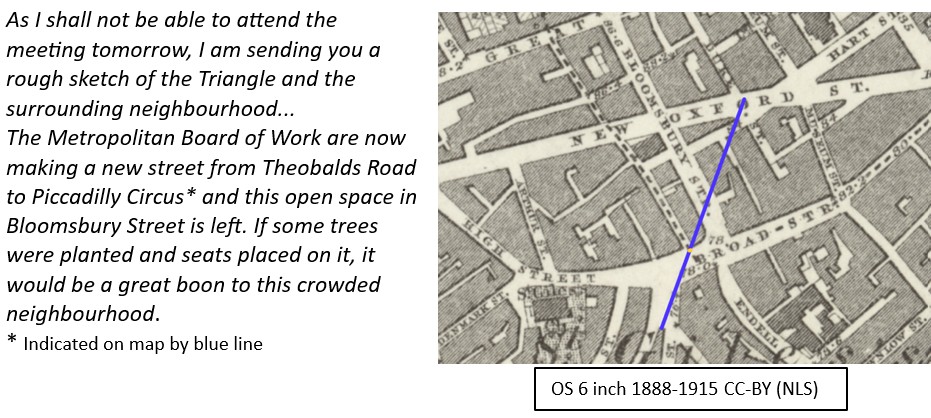
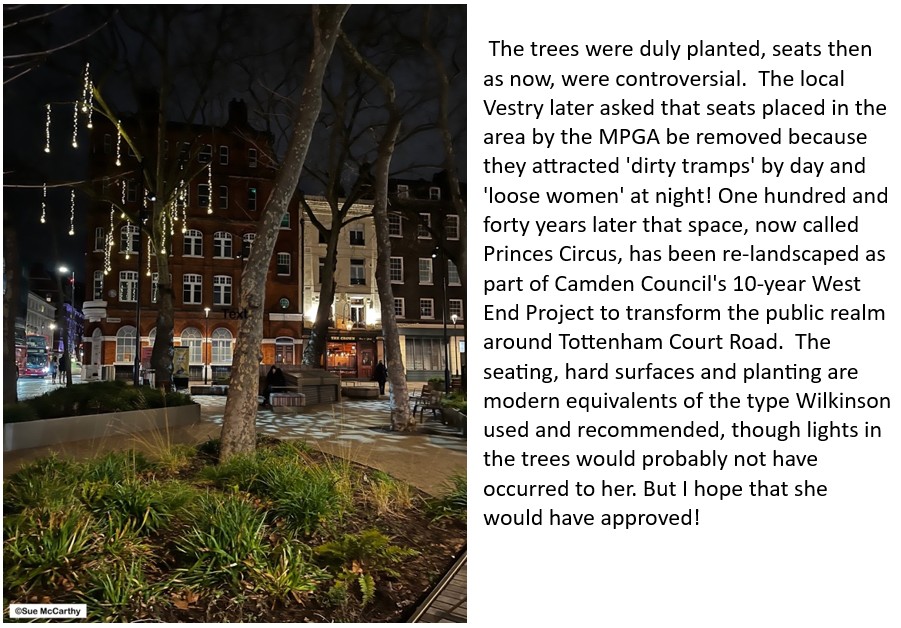
I know my profession and charge accordingly
Wilkinson was initially appointed to the MPGA on a ladylike ‘Honorary’ basis but her role did not remain ‘Honorary’ for long. In 1886, she wrote:
As I have before stated, my time I am very glad to give to the work, but I cannot afford to lose by it. I think it would be better for me to drop the “Hon” and make a charge which would fully cover all expenses.
As well as ensuring that she was paid properly for her work with the MPGA, she also found time to take private clients. Bloomsbury commissions included gardens at the London School of Medicine for Women and the New Hospital for Women (later the Elizabeth Garrett Anderson Hospital).
In an interview for the Women’s Penny Paper she explained,
I certainly do not let myself be underpaid as many women do. There are people who write to me because I am a woman, and think I will ask less than a man. That I will never do. I know my profession and charge accordingly, as all women should do…
Both the Kyrle Society and the MPGA worked to create open spaces and playgrounds, often through transforming disused burial grounds and graveyards. This was only a part of the Kyrle Society’s broader aim to ‘bring beauty to the lives of the poor’ so Lord Brabazon (later Earl of Meath) established the MPGA to concentrate on gardens and children’s playgrounds.
Green Lungs for London
In the almost 20 years she was with the MPGA, Fanny Wilkinson laid out over 75 gardens all over London from Haverstock Hill in the north to Camberwell in the South, from Wandsworth in the west to Plaistow in the east. The largest were Meath Gardens in Bethnal Green and Myatt’s Field in Camberwell, but she landscaped many smaller spaces including Red Lion Square in Holborn, created small, asphalted playgrounds and promoted tree planting. Her leaflet advising on planting and maintaining street trees was sent to every London borough.
Wilkinson’s most prestigious project with the Kyrle Society was to lay out Vauxhall Park in south London. The eight-and-a-half acre site included the former London home of Millicent Garrett Fawcett and her husband, the economist and politician, Henry Fawcett. A public campaign after Henry Fawcett’s death, saved the land from development, and raised funds to create the park which was opened in 1900 by the Prince of Wales. Among those present were Octavia Hill, founder (with her sister Miranda) of the Kyrle Society and Emma Cons, founder of Morley College and first woman Alderman of the London County Council. Emma Cons had worked with Octavia Hill on housing projects and was a staunch supporter of horticultural training for women.
Encouraging the next generation
Like her friends the Garretts, Fanny Wilkinson was committed to supporting younger women. She took pupils for which she charged ‘not less than £100 a year’. One of whom was Emmeline Sieveking, whose father Edward Sieveking, was physician in ordinary to Queen Victoria and a supporter of higher education for women. Emmeline became Wilkinson’s assistant and part of the formidable group of women who managed to turn Swanley Horticultural College in Kent from an all-male establishment to a women-only college. Later still, she became Fanny’s sister-in-law when she married Matthew Wilkinson.
Capturing the College

Most of the buildings have gone, but the gates still frame the view from the College down a fine avenue of limes.
The campaign was mounted by Emma Cons. Aged 58 she and her companion Ethel Everest challenged the prejudice that horticultural study and physical work were too hard for women, by working alongside the male students at Swanley for a few weeks. Fellow advocates, Drs Elizabeth Garrett Anderson and Edward Sieveking extolled the positive health benefits of horticultural training, Henry Milner (of the Crystal Palace School where Fanny Wilkinson had trained) and Wilkinson lent support. A ‘Ladies Branch’ opened in 1891 with five students; by 1896 women graduates from Swanley were employed at Kew. By 1898, women outnumbered men. When the male Principal resigned because, ‘…the views of the ladies who hold a prominent position on the board are materially divergent from my own’ and his successor was conscripted to serve in the Boer War, Wilkinson’s brother Matthew stepped in to fill the breach until Fanny Wilkinson was appointed as Principal of Swanley Women’s Horticultural College, a position she held from 1902 to 1916 and 1921-22.
Wilkinson retired to bred prize-winning goats in Suffolk and died aged 95 in January 1951.
Sue is leading her walk – ‘Fanny Wilkinson’s Green Lungs for London’ on 7 June as part of London Open Gardens 2025.
Image of Fanny Wilkinson:
From: Portrait Album of Who’s Who at the International Congress of Women, London 1899, Courtesy of Harvard University https://nrs.lib.harvard.edu/urn-3:rad.schl:3163312 Accessed 7 May 2025
References:
MPGA, Minute Books, London Metropolitan Archives, London
Women’s Penny Paper, Vol.III, No.107, 8 November 1890
British Newspaper Archive online (South London Press, 9 April 1881, Morning Post, 6 July 1881, Norwood News, 24 May 1884)
Elizabeth Crawford, Enterprising Women, The Garretts and their Circle (Francis Boutle, 2002)
Opitz, Donald L. “‘A Triumph of Brains over Brute’: Women and Science at the Horticultural College, Swanley, 1890–1910.” Isis, vol. 104, no. 1, 2013, pp. 30–62 https://via.library.depaul.edu/snl-faculty-pubs/45. Accessed 7 May 2025
Sue McCarthy