

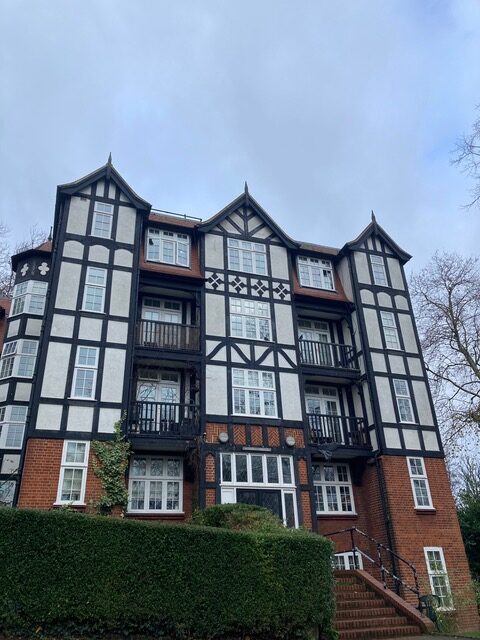
The Holly Lodge estate is a distinctive part of Highgate with the mock Tudor towers a distinctive sight near Highgate Cemetery. However, the estate also consists of a number of houses and side roads off Highgate West Hill. It is a relatively unknown part of an area often associated with literary figures, and one who is currently the subject of a guided walk is Stella Gibbons, author of Cold Comfort Farm- a satiric and much-loved classic of the early 1930s. But Stella wrote several more books over her long career, sometimes set in and around Hampstead and Highgate.
Holly Lodge Estate
Holly Lodgeitself was once owned by Baroness Angela Burdett-Coutts during the 19th century after she inherited a vast fortune from her step-grandmother, who married one of the founders of the Coutts bank.
Traces of the beautiful planting surrounding the demolished house are still visible in the gardens of the current estate. Coutts was an impressive philanthropist, but shocked Queen Victoria when she married a man much younger than herself, when she was in her 60s. He survived her by another couple of decades until 1921, when the estate was sold for development. A distinctive aspect was the creation of the mansion blocks, nicknamed Tudor towers, aimed at single working women, who would be able to afford the small bedsits within. The 1920s saw much discussion about the 2 million surplus women, who would never marry, but instead sought careers and freedom from family responsibilities by leaving home.
Stella Gibbons and Cold Comfort Farm
Stella Gibbons’ heroine Flora Poste is one example. Her ability to problem solve is triumphantly displayed by rescuing the Starkadder family, manipulated by Great Aunt Ada, who famously saw something nasty in the woodshed as a child. Gibbons was the product of what would now be described as a dysfunctional family, orphaned when she was 24, and supporting her younger brothers by journalism. She was born in Kentish Town and lived in the Holly Lodge Estate for the last 40 years of her life.
Two million surplus women
Other local authors drew attention to the plight of ‘Business Women’ – the subject of one of John Betjeman’s favourite poems. Betjeman spent part of his childhood on Highgate West Hill. J.B. Priestley lived at the Grove and demonstrated the precarious nature of female shop workers in his play An Inspector Calls, where a mysterious inspector reveals to the family how they have collectively destroyed the life of Eva Smith, a former shop assistant, through the careless attitude of the rich.

Learn more about Stella Gibbons and the Holly Lodge Estate on Oonagh’s walk on 21 June https://www.eventbrite.co.uk/e/walking-tour-cold-comfort-farm-in-highgate-tickets-1325024837959?aff=erelexpmlt